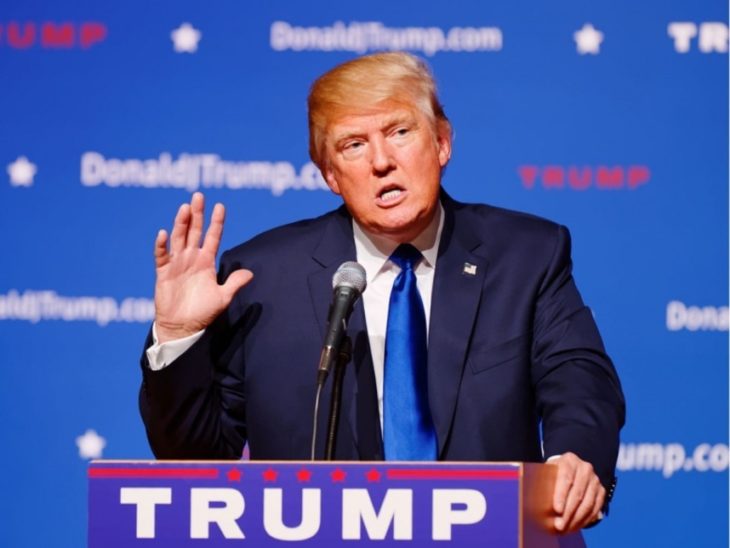
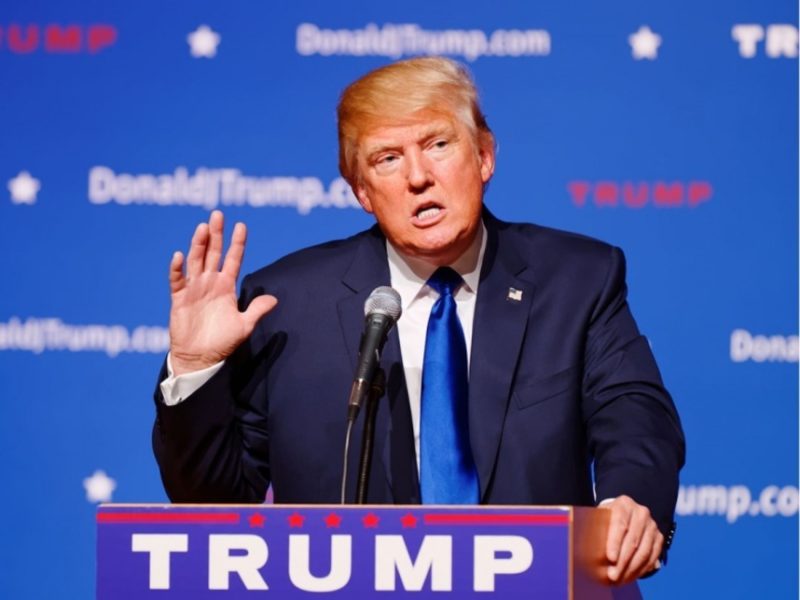
Yesterday Donald Trump made his initial foray into foreign policy, announcing that “America First will be the major and overriding theme of my administration.”
Today the slogan is generating criticism from some who remember what the term “America First” meant in the early 1940s.
CNN proclaimed that “Trump’s ‘America First’ has ugly echoes from U.S. History.” The Chicago Tribune opined that “Donald Trump’s new America First slogan has old baggage from Nazi Era.” Radio host Glenn Beck managed to link Trump with David Duke, the Ku Klux Klan, and Neo-Nazis during his broadcast this morning.
The America First Committee, as the historically-minded know, was an isolationist movement that attempted to prevent the United States from intervening on behalf of the Allies before World War II. Its most noteworthy spokesman was aviator Charles Lindbergh, an unabashed admirer of the Nazi Luftwaffe. It disbanded soon after the Japanese attack on Pearl Harbor.
Certainly, someone on Trump’s campaign team knew the historical significance of the term. They knew, but they didn’t care. Intellectuals who remember the now-discredited “America First” of 75 years ago are not going to vote for Trump anyway. Trump’s advisors were also confident that the term, once identified with anti-Semitism, would not tinge Trump in that way due to his strong pro-Israel stand.
Trump’s speech tries to re-invent the term for a modern audience.
“Many Americans must wonder why our politicians seem more interested in defending the borders of foreign countries than their own,” Trump declared. “Americans must know that we are putting the American people first again. On trade, on immigration, on foreign policy – the jobs, incomes and security of the American worker will always be my first priority.”
But is Trump’s “America First” isolationist like its precursor from the 1940s? Or is it interventionist?
First Trump criticizes the interventions of the recent past.
“It all began with the dangerous idea that we could make Western democracies out of countries that had no experience or interest in becoming a Western democracy. We tore up what institutions they had and then were surprised at what we unleashed. Civil war, religious fanaticism; thousands of American lives, and many trillions of dollars, were lost as a result. The vacuum was created that ISIS would fill. Iran, too, would rush in and fill the void, much to their unjust enrichment.”
Yet then Trump endorses future interventions.
“Iran cannot be allowed to have a nuclear weapon and, under a Trump administration, will never be allowed to have a nuclear weapon.”
Never? At what cost? War?
“And then there’s ISIS,” Trump continued. “I have a simple message for them. Their days are numbered. I won’t tell them where and I won’t tell them how. We must as, a nation, be more unpredictable. But they’re going to be gone. And soon.”
So we are going to intervene in foreign affairs, at least against ISIS. But those future interventions will be essential and winnable.
“I will not hesitate to deploy military force when there is no alternative. But if America fights, it must fight to win. I will never send our finest into battle unless necessary – and will only do so if we have a plan for victory.”
As if his predecessors didn’t think that their interventions were essential and winnable too. They did not think that they had a plan for defeat. Whoever does?
So what does Trump’s America First mean?
It means just what it says. Us first, everyone else second.
That’s Trump’s idea of a “disciplined, deliberate and consistent foreign policy” that “will endure for generations.”